5600 Palm Lake Circle, Orlando Fl. 32819
info@ipircm.com
877-422-7221

If you work in a medical billing department, you already know that not all insurance is the same. Two of the biggest government programs in the United States, Medicare and Medicaid, often get mixed up because their names sound similar. But when it comes to billing, they work in very different ways.
Getting these differences wrong can lead to claim denials, delayed payments, and compliance issues. We will break down what Medicare and Medicaid are, how their billing processes differ, and what your practice needs to know to bill both correctly.
Medicare is a federal health insurance program mainly for people aged 65 and older. It also covers some younger people with certain disabilities or conditions like End-Stage Renal Disease. Since it is a federal program, the rules are consistent across all fifty states.
Medicare is divided into different parts:
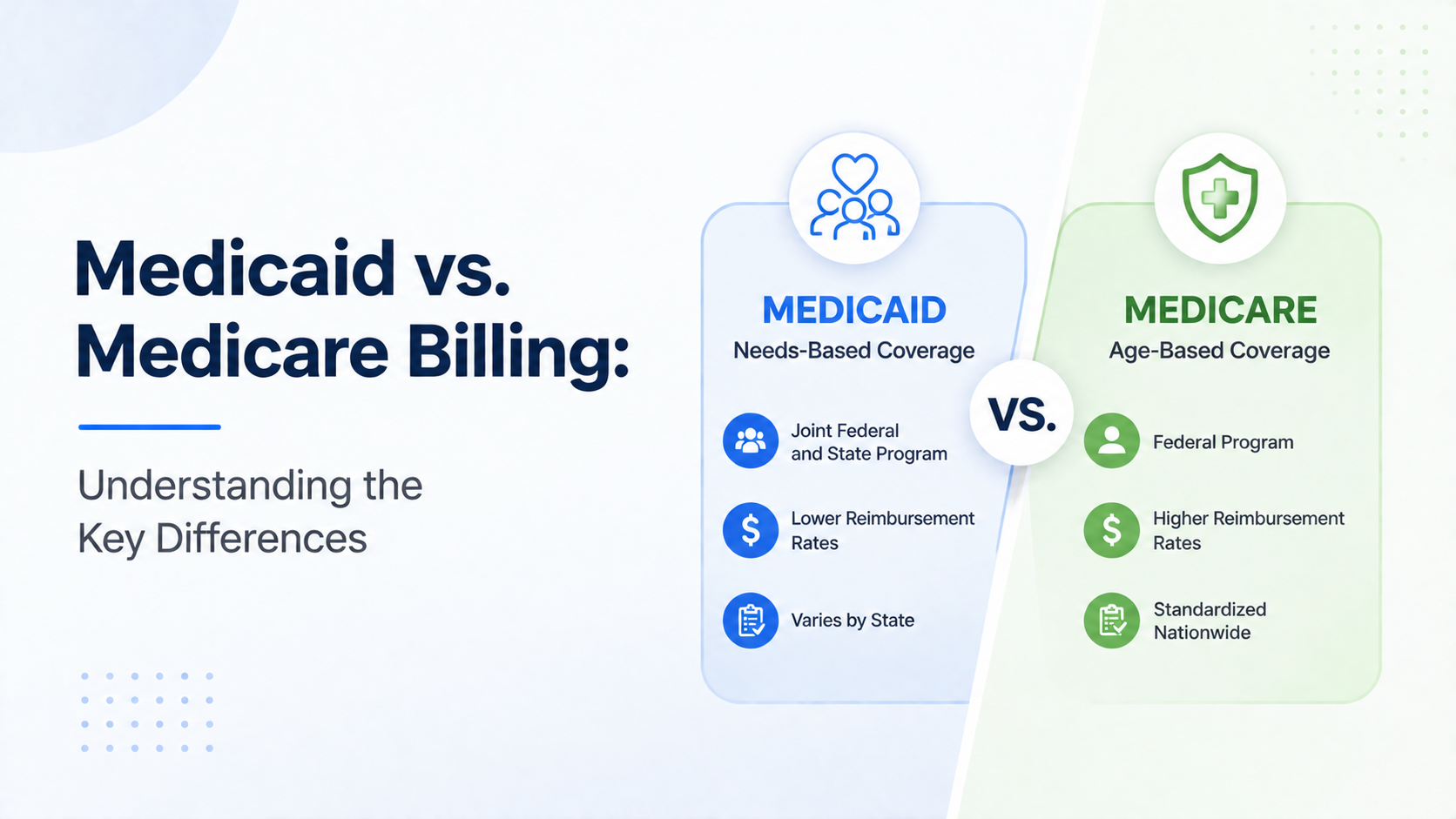
Medicaid is a joint federal and state program that provides health coverage to low income individuals and families. Unlike Medicare, Medicaid eligibility and benefits can vary significantly from one state to another because each state runs its own program within federal guidelines.
Medicaid covers a wide range of services, but exactly what is covered, how much providers are paid, and which patients qualify depends heavily on the state the practice is billing in.
Medicare is run entirely by the federal government through the Centers for Medicare and Medicaid Services, or CMS. Medicaid, on the other hand, is managed by individual states, with federal funding and oversight. This means billing rules that apply in one state may not apply in another when it comes to Medicaid, while Medicare rules stay the same nationwide.
Medicare eligibility is mostly based on age or disability status, and it does not depend on income. Medicaid eligibility is based on income and household size, and the exact thresholds vary by state. Some patients even qualify for both programs at the same time, which is known as dual eligibility.
Medicare claims are generally submitted using standardized national forms and follow consistent coding guidelines across the country. Medicaid claims often require state-specific forms, additional documentation, or prior authorization steps that are not required by Medicare. Billing staff need to know the specific Medicaid rules for each state they work with.
Medicare reimbursement rates are set at the federal level and are generally more predictable. Medicaid reimbursement rates are set by each state and tend to be lower than both Medicare and private insurance. This is one reason some providers choose to limit the number of Medicaid patients they accept.
Medicaid programs are more likely to require prior authorization for certain services, and the specific requirements differ from state to state. Medicare has prior authorization requirements too, but they tend to be more standardized and predictable across the country.
Both programs have deadlines for submitting claims, but these deadlines are not always the same. Medicare generally allows claims to be filed within twelve months of the date of service. Medicaid filing deadlines vary by state and can be shorter, so billing teams need to track deadlines separately for each program.
When a patient has both Medicare and Medicaid, known as dual eligibility, billing becomes more complex. In most cases, Medicare is billed first as the primary payer, and Medicaid is billed second to cover remaining costs. Getting this order wrong is a common cause of claim denials.
Billing Medicare and Medicaid correctly takes more than just knowing the basics. It requires staying current with federal rules, tracking state-specific Medicaid requirements, and managing coordination of benefits for dual eligible patients without missing a deadline or a detail.
IPIRCM’s medical billing service is built to handle exactly this kind of complexity, helping practices reduce denials, stay compliant, and get reimbursed correctly for both Medicare and Medicaid claims. Reach out to IPIRCM today to simplify your billing process and keep your revenue cycle running smoothly.


“We built IPIRCM to set standards, not follow trends — helping your practice move forward without limits.”
We didn't build these companies to follow trends — we built them to set standards. From IPIPAK's trusted BPO, to IPIRCM's full-cycle U.S. medical billing, to IPITECHNO's cutting-edge IT solutions, every company exists to move your business forward without limits.
Together we are more than three brands. We are one vision: to make business simpler, faster, and stronger for those who dare to grow. It is an honor to lead this group — and a greater honor to serve you.