5600 Palm Lake Circle, Orlando Fl. 32819
info@ipircm.com
877-422-7221

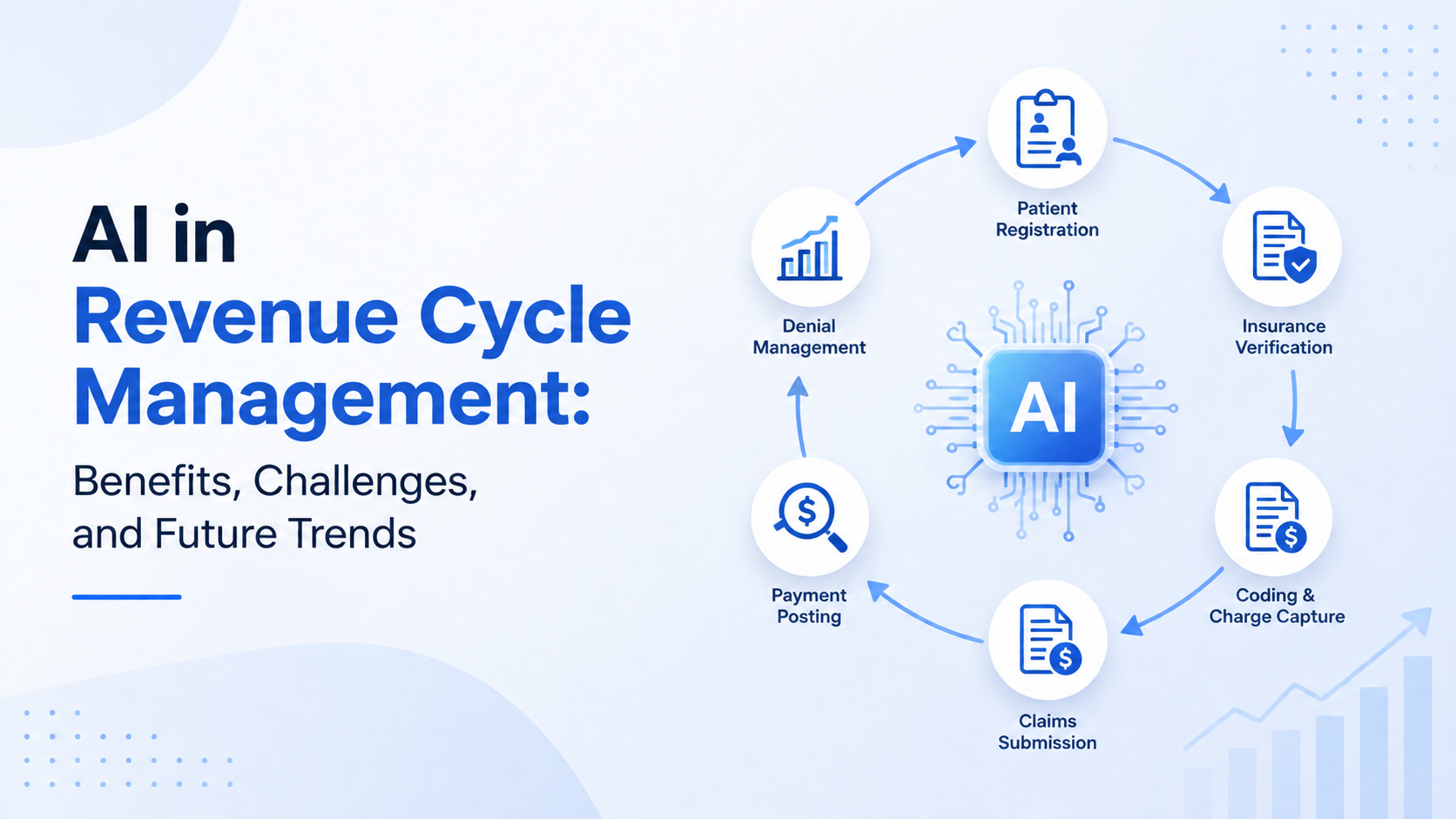
Healthcare providers deal with a lot of moving parts every single day. Patients need care, insurance companies need claims, and practices need to get paid on time. This entire process, from the moment a patient books an appointment to the moment the final payment is collected, is called Revenue Cycle Management, or RCM.
For years, RCM has relied heavily on manual work. Staff members spend hours verifying insurance, entering data, checking codes, and following up on unpaid claims. This takes time, costs money, and leaves room for human error. That is where artificial intelligence is starting to change the game.
here, we will look at how AI is being used in revenue cycle management, what benefits it brings, the challenges providers face while adopting it, and what the future may look like.
Revenue cycle management is the financial process that healthcare providers use to track patient care from registration to final payment. It covers steps like:
Each of these steps needs to be accurate. A small mistake, like a wrong code or a missed eligibility check, can delay payment for weeks or cause a claim to be denied altogether.
AI is not replacing the entire billing process. Instead, it is being added into specific parts of the cycle where speed and accuracy matter the most. Some common uses include:
AI can scan a claim in seconds and catch errors that a human might miss after a long shift. This means fewer denied claims and faster reimbursements for providers.
Billing staff spend less time on repetitive tasks like data entry and eligibility checks. This frees them up to focus on more complex cases, like appealing denied claims or handling patient questions.
When AI handles routine tasks, practices need less manual labor to keep the billing process running. Over time, this can lead to real savings for healthcare providers.
Faster claim approvals and quicker payment posting mean money comes in sooner. For smaller practices, this can make a real difference in day to day operations.
AI tools that predict denials before submission give billing teams a chance to fix problems early. This reduces the back and forth with insurance companies and shortens the payment cycle.
Patients get clearer bills, faster answers to insurance questions, and more payment options. A smoother billing experience often leads to higher patient satisfaction and better collections.
AI brings real value, but it is not a simple plug and play solution. Providers face several challenges when adopting it.
Setting up AI tools, integrating them with existing systems, and training staff to use them takes money and time. Smaller practices may find this cost hard to justify at first.
Healthcare data is sensitive. Any AI system handling patient information must meet strict privacy laws like HIPAA. A poorly secured AI tool could put patient data at risk.
Many healthcare practices still use older billing software. Connecting new AI tools with these older systems is not always straightforward and may require custom work.
Billing teams who are used to manual processes may resist switching to AI driven workflows. Training staff properly takes time, and without it, the technology will not be used to its full potential.
AI models learn from data, and if that data has gaps or errors, the AI can make mistakes too. Human oversight is still needed to catch anything the system gets wrong.
Healthcare billing rules change often, and AI tools need to stay updated with the latest payer policies and government regulations. Falling behind on updates can cause more problems than it solves.
The role of AI in RCM is still growing, and a few trends are worth watching closely.
As these trends develop, the practices that adopt AI early will likely see stronger financial performance and fewer administrative headaches compared to those relying only on manual processes.
AI is reshaping revenue cycle management, but it works best when paired with experienced billing professionals who understand the healthcare industry. The technology can speed up claims, reduce denials, and cut costs, but it still needs the right people managing it to deliver consistent results.
If you are a healthcare provider looking to strengthen your billing process without the guesswork of managing new technology on your own, IPIRCM can help. Our Revenue Cycle Management services combine industry experience with modern billing practices to reduce claim denials, speed up reimbursements, and improve your practice’s overall cash flow. Reach out to IPIRCM today to see how we can help your practice get paid faster and with fewer headaches.


“We built IPIRCM to set standards, not follow trends — helping your practice move forward without limits.”
We didn't build these companies to follow trends — we built them to set standards. From IPIPAK's trusted BPO, to IPIRCM's full-cycle U.S. medical billing, to IPITECHNO's cutting-edge IT solutions, every company exists to move your business forward without limits.
Together we are more than three brands. We are one vision: to make business simpler, faster, and stronger for those who dare to grow. It is an honor to lead this group — and a greater honor to serve you.