5600 Palm Lake Circle, Orlando Fl. 32819
info@ipircm.com
877-422-7221

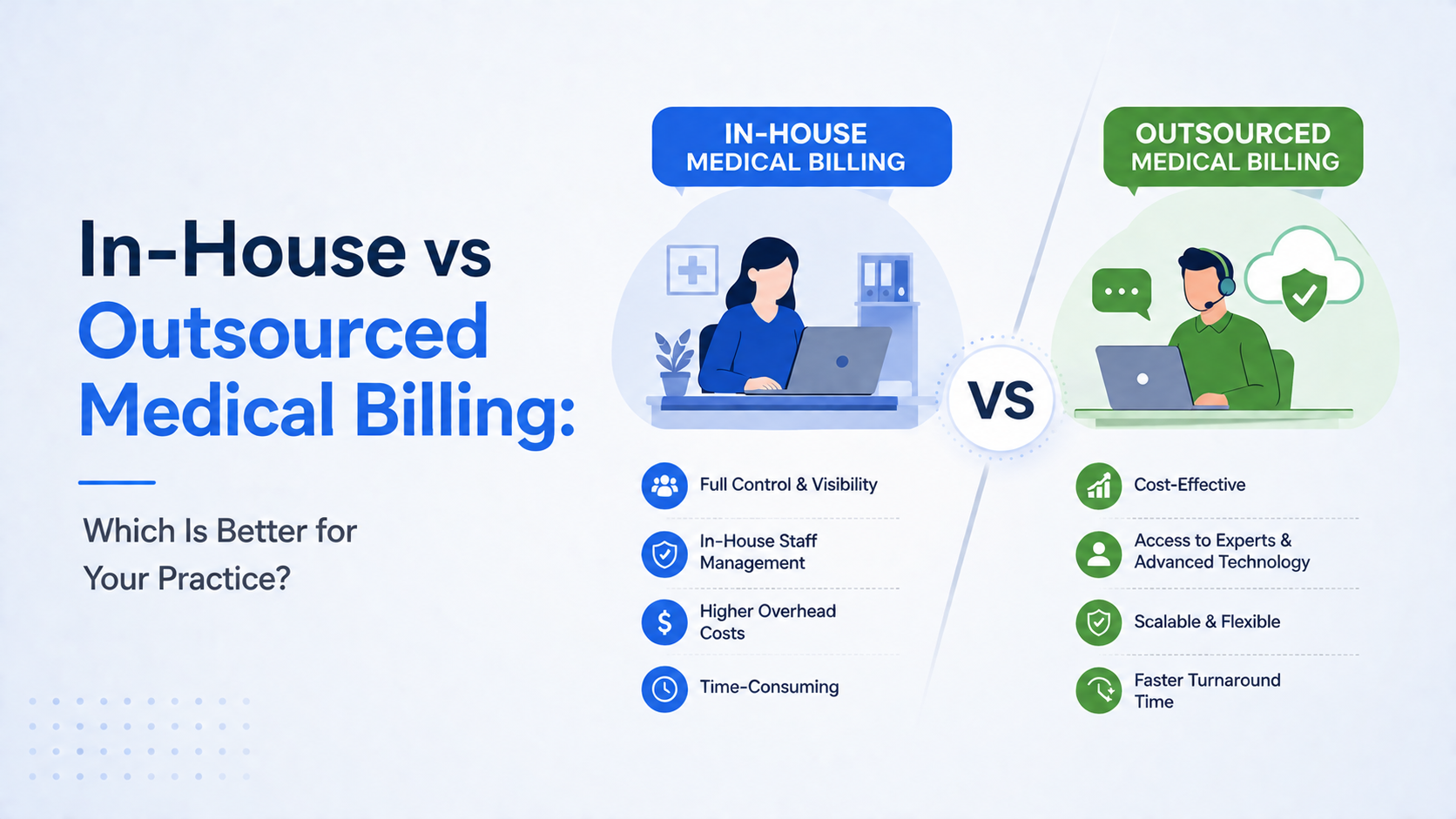
One of the biggest decisions a healthcare practice makes is how to handle its medical billing. Some practices keep everything in-house, hiring their own staff to manage claims and collections. Others choose to outsource billing to a specialized company that handles it on their behalf.
There is no single right answer for every practice. The best choice depends on the size of the practice, its budget, and how much control the provider wants over the billing process. Here, we will compare what in-house and outsourced billing actually involve, weigh their pros and cons, and help you figure out which option might work better for your practice.
In-house medical billing means a practice hires and manages its own billing staff internally. These employees handle everything from coding and claim submission to payment posting and denial follow up, all while working directly within the practice.
With in-house billing, the practice owns the entire process, including the software, the training, and the day to day management of the team.
Outsourced medical billing means a practice hires an outside company to manage some or all of its billing functions. This can include everything from coding and claim submission to denial management and patient billing support.
The billing company typically uses its own staff, technology, and expertise to handle the process, while the practice focuses on patient care instead of the administrative side of billing.
In-house billing requires paying salaries, benefits, training, and the cost of billing software and infrastructure. These costs stay fairly fixed regardless of how many claims are processed. Outsourced billing usually works on a percentage of collections or a flat fee, which means costs scale with the practice’s actual revenue. For many smaller practices, outsourcing turns out to be more cost effective in the long run.
In-house billing gives practices full control over every step, from how staff are trained to how quickly issues are addressed. Outsourced billing means handing some of that control over to an outside partner, though most reputable billing companies provide regular reporting and communication to keep practices informed.
Billing rules, payer requirements, and coding guidelines change frequently. In-house teams need ongoing training to stay current, which takes time and resources. Outsourced billing companies typically specialize in this work, meaning their staff are often more consistently up to date with the latest changes across multiple payers and states.
As a practice grows, in-house billing often means hiring more staff, which takes time and adds overhead. Outsourced billing companies can usually scale up quickly to handle more claims without the practice needing to hire or train anyone new.
In-house billing requires the practice to purchase, maintain, and update its own billing software. Outsourced billing companies typically already have advanced billing technology in place, so practices benefit from better tools without the upfront investment.
In-house teams may struggle to keep up with denial follow up if they are stretched thin across other tasks. Outsourced billing companies often have dedicated staff focused specifically on denials and collections, which can lead to faster resolution and better recovery rates.
In-house billing keeps data within the practice’s own systems, which can feel more secure to some providers. However, outsourced billing companies that are HIPAA compliant often have stronger security measures in place than a small practice could build on its own, since data protection is central to their business.
In-house billing can become expensive and difficult to manage if staff turnover is high or if the team struggles to keep up with changing payer rules. It also requires ongoing investment in training and technology to stay competitive.
Outsourced billing means giving up some day to day control, and choosing the wrong billing partner can lead to communication gaps or inconsistent service. Doing proper research before selecting a billing company is important to avoid these issues.
The right choice depends on a few key factors.
There is no universal answer, and some practices even choose a hybrid approach, keeping certain tasks in-house while outsourcing others like denial management or patient billing support.
If you’re looking to reduce administrative workload, improve cash flow, and gain access to experienced billing professionals without the expense of maintaining a large in-house team, IPIRCM is here to help. Our comprehensive revenue cycle management services include medical billing and claim submission, accurate medical coding, accounts receivable management, denial management and appeals, and provider credentialing. Whether you’re considering outsourcing your billing or simply exploring your options, our team can help you choose the approach that best fits your practice’s goals. Contact IPIRCM today to learn how we can streamline your billing process and support your long-term success.


“We built IPIRCM to set standards, not follow trends — helping your practice move forward without limits.”
We didn't build these companies to follow trends — we built them to set standards. From IPIPAK's trusted BPO, to IPIRCM's full-cycle U.S. medical billing, to IPITECHNO's cutting-edge IT solutions, every company exists to move your business forward without limits.
Together we are more than three brands. We are one vision: to make business simpler, faster, and stronger for those who dare to grow. It is an honor to lead this group — and a greater honor to serve you.