5600 Palm Lake Circle, Orlando Fl. 32819
info@ipircm.com
877-422-7221

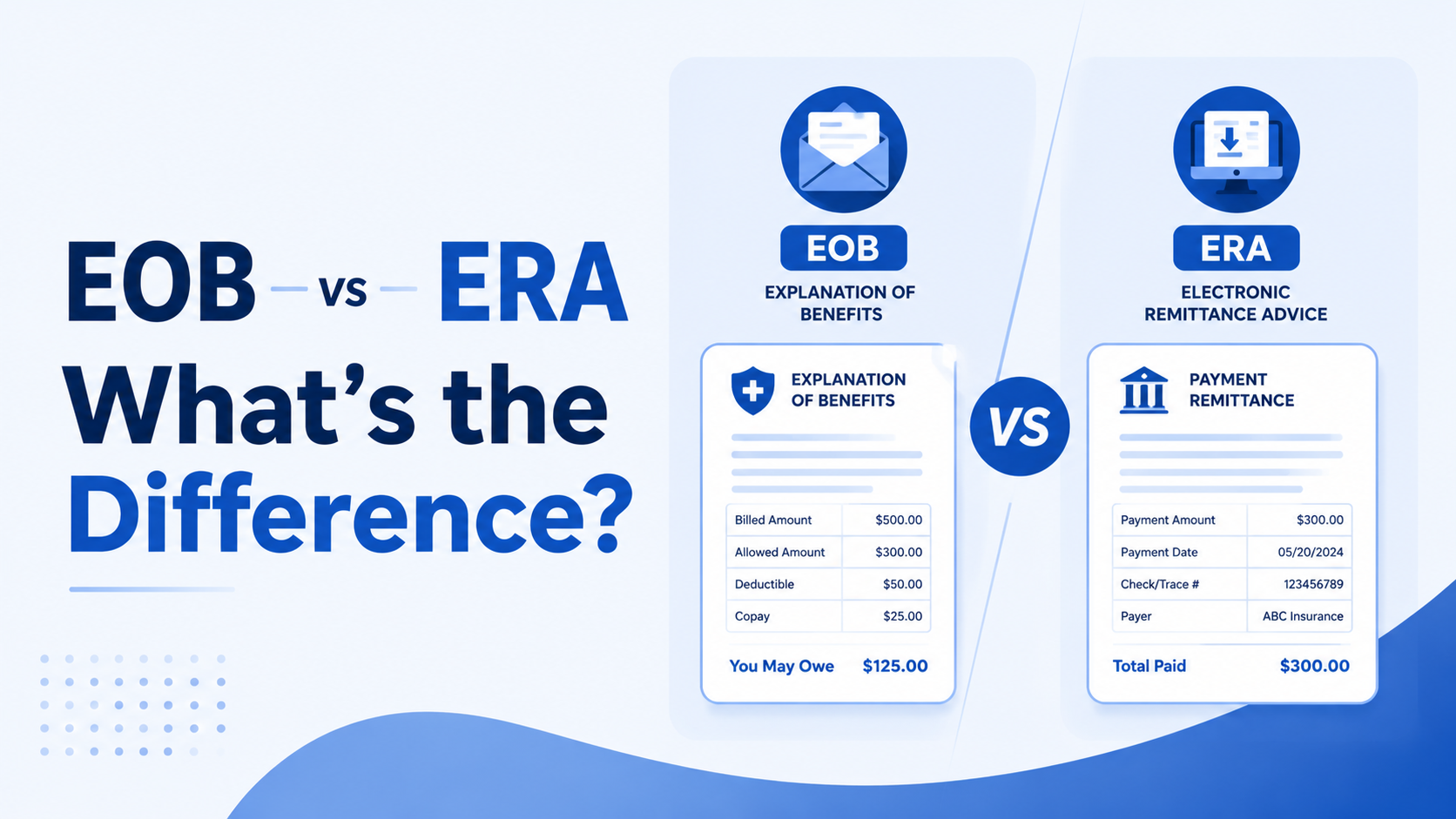
If you work in medical billing, you have likely seen both an EOB and an ERA land in the same day, sometimes for the exact same claim. They look like they serve the same purpose, and in many ways they do, but they are built for different audiences and used differently inside a billing workflow. Understanding the difference matters more than it seems, because mixing them up or ignoring one in favor of the other is a common reason payment posting gets delayed and reconciliation errors slip through unnoticed.
This guide breaks down exactly what an EOB and an ERA are, how they differ, and why both matter for keeping your practice’s revenue cycle accurate and on track.
An EOB, or Explanation of Benefits, is a paper or PDF document that a payer sends explaining how a specific claim was processed. It is typically directed at the patient, though practices receive a version of it as well, often called a Remittance Advice when it comes to the provider.
An EOB usually includes the following:
EOBs are written to be understood by patients who are not familiar with billing codes, so the language tends to be simple and the format tends to be a standard printed layout or PDF.
An ERA, or Electronic Remittance Advice, is the digital, standardized version of the same payment information, but built specifically for practice management and billing software to read automatically. It follows a strict format known as the ANSI 835 transaction standard, which allows billing systems to pull in the payment details without anyone manually typing numbers from a printed page.
An ERA typically includes:
Because ERAs are machine-readable, they are the backbone of automated payment posting, which is why most billing systems are built around handling ERA files rather than paper EOBs.
| Feature | EOB | ERA |
|---|---|---|
| Format | Paper or PDF | Electronic file (ANSI 835 standard) |
| Primary audience | Patients (and providers, in a similar form) | Billing software and practice management systems |
| Readability | Plain language, easy for patients to understand | Coded format, meant for software to process |
| Posting method | Manual entry required | Can be auto-posted directly into billing software |
| Speed | Slower to process, since it requires manual review | Faster, since it can be posted automatically |
| Error risk | Higher, due to manual data entry | Lower, when auto-posting rules are set up correctly |
| Denial codes | Written out in plain text | Standardized CARC and RARC codes |
Practices that rely only on EOBs are stuck manually entering payment data line by line, which slows down the entire revenue cycle and increases the chance of typos or missed adjustments. Practices set up to receive and auto-post ERAs can apply payments to patient accounts within minutes of the payer releasing them, keeping accounts receivable current and accurate.
ERAs use standardized CARC (Claim Adjustment Reason Codes) and RARC (Remittance Advice Remark Codes), which make it much easier to track denial trends across payers and claim types. Since these codes are consistent across payers, a billing team can run reports and spot patterns, such as a specific payer frequently denying a certain CPT code, much faster than sorting through plain-language explanations on paper EOBs.
When a payment is posted from an ERA, the numbers come directly from the payer’s system, reducing the risk of transcription errors. EOBs require someone to read the document and manually enter the same numbers, which introduces room for mistakes, especially when volume is high or staff are stretched across multiple tasks.
EOBs still matter, because they are what patients see and use to understand their own responsibility for a bill. Even in a practice that runs primarily on ERAs internally, patients need an EOB-style explanation, whether generated by the payer or by the practice’s own patient statement process, to understand their portion of the cost.
Start by enrolling with every payer for ERA and EFT capability wherever it is offered, since this is what enables auto-posting and faster cash flow. Once that is in place, set up auto-posting rules carefully and review exceptions regularly rather than assuming everything posted correctly, and pull CARC and RARC code reports monthly so denial trends get caught before they grow into a bigger AR problem.
At the same time, keep a process for handling the occasional payer that still only sends paper EOBs, so those claims do not get lost in the shuffle, and reconcile ERA payment totals against bank deposits on a regular schedule to confirm nothing was missed or misapplied.
EOBs and ERAs are really two versions of the same information, one built for people and one built for software, and a well-run revenue cycle needs both handled correctly. Getting ERA enrollment set up properly, posting payments accurately, and using denial codes to catch patterns early are exactly the kind of detailed, ongoing tasks that keep a practice’s cash flow healthy. If your team is still manually working through paper EOBs or your ERA setup is not fully optimized across all your payers, reach out to IPIRCM at 877-422-7221 or visit our Revenue Cycle Management services page to see how our team can streamline payment posting and keep your revenue cycle running smoothly from claim submission all the way through reconciliation.


“We built IPIRCM to set standards, not follow trends — helping your practice move forward without limits.”
We didn't build these companies to follow trends — we built them to set standards. From IPIPAK's trusted BPO, to IPIRCM's full-cycle U.S. medical billing, to IPITECHNO's cutting-edge IT solutions, every company exists to move your business forward without limits.
Together we are more than three brands. We are one vision: to make business simpler, faster, and stronger for those who dare to grow. It is an honor to lead this group — and a greater honor to serve you.