5600 Palm Lake Circle, Orlando Fl. 32819
info@ipircm.com
877-422-7221

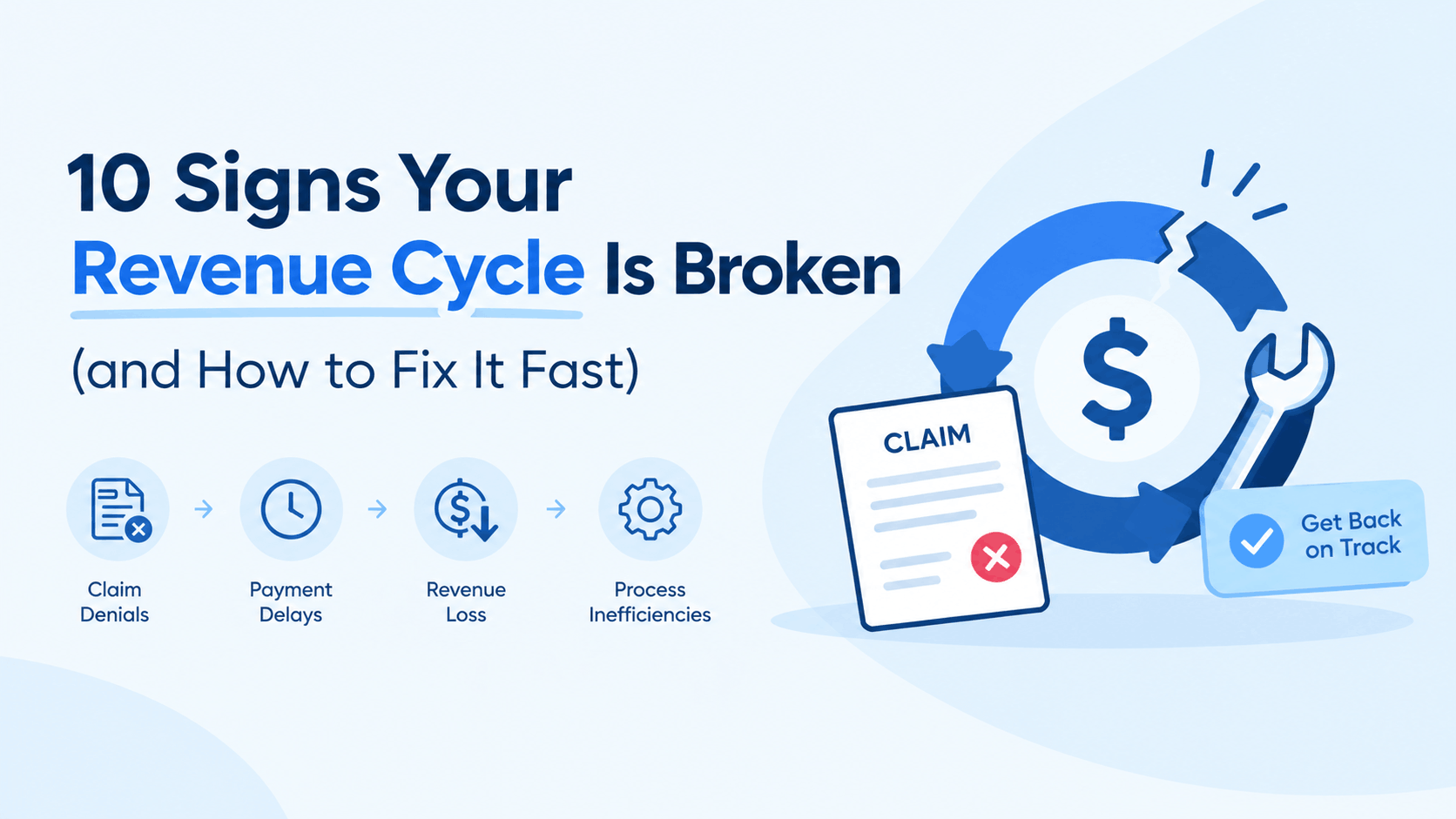
Most practices don’t realize their revenue cycle is broken until cash flow gets tight. Claims take longer to pay, staff spend more time on rework, and the money you earned seems to arrive later every month, or not at all. The problem is rarely one big failure. It is usually a handful of small breakdowns that add up to thousands of dollars in lost or delayed revenue.
Here are the most common warning signs of a broken revenue cycle, the numbers that expose them, and the practical steps that help you fix the problem before it gets worse.
The revenue cycle is every step between a patient scheduling an appointment and your practice collecting the final payment. It includes registration, insurance verification, charge capture, coding, claim submission, payment posting, denial management, A/R follow-up and patient billing.
Because each step depends on the one before it, a small mistake early on tends to grow into a bigger problem later. A wrong insurance ID at registration becomes a rejected claim. A missed charge becomes lost revenue. An unworked denial becomes a write-off. Revenue cycles typically break down for a few common reasons:
Days in accounts receivable measures how long it takes, on average, to collect payment after a service is delivered. When this number creeps up, it means claims are getting stuck somewhere, whether in submission, payer review or follow-up.
Many practices aim to keep days in A/R somewhere in the 30 to 40 day range, though the right target varies by specialty and payer mix. If yours is trending upward month after month, your revenue cycle is losing momentum.
Some denials are normal. A steady stream of them is not. If a meaningful share of your claims come back denied, it usually points to problems with eligibility checks, authorizations, coding or documentation.
The bigger risk is what happens next. Many denials are never appealed or resubmitted, especially when staff are busy. Each one that goes unworked is revenue you already earned but never collected.
A clean claim is one that is accepted and processed on the first submission without edits or corrections. A commonly cited goal is a clean claim rate of around 95% or higher.
If your rate is well below that, your team is spending time fixing avoidable errors and waiting on resubmissions. Common culprits include incorrect patient demographics, missing modifiers, invalid codes and incomplete insurance information.
The net collection rate compares what you actually collect with what you are contractually entitled to collect after adjustments. It is one of the clearest measures of billing performance because it shows how much collectible revenue you are truly capturing.
A healthy practice often aims for a net collection rate in the mid-to-high 90s. If yours has dropped, you are likely losing money to write-offs, missed follow-ups, underpayments or timely filing issues.
If it takes days or weeks after a visit for charges to be entered, cash flow suffers immediately. Late charge entry also increases the chance of errors, because providers and staff have to recall details long after the visit.
Missed charges are even worse. A service that is never billed is revenue that never arrives, and it is often invisible because nobody knows to look for it. Signs of this problem include:
As high-deductible plans become more common, patients carry a larger share of the bill. If your practice does not collect patient responsibility effectively, unpaid balances can pile up quickly.
Warning signs include statements going out late, patients surprised by what they owe, and no clear process for payment plans or reminders. Estimating patient costs at the time of service and communicating them clearly makes a real difference.
Coding drives reimbursement. Incorrect or unsupported codes can trigger denials and audits, while undercoding quietly leaves money on the table. Providers who are cautious about billing may consistently choose lower-level codes than their documentation supports.
If your team has not audited coding recently, it is worth reviewing a sample of encounters. Small patterns, such as missing modifiers or outdated codes, can have a large financial impact over time.
If you cannot easily answer basic questions about your finances, that is a warning sign in itself. Ask yourself whether you can quickly tell:
Without regular reporting, problems stay hidden until they become serious. A well-run revenue cycle relies on numbers that are reviewed consistently, not just when something goes wrong.
Billing is detail-heavy work, and it requires up-to-date knowledge of payer policies, coding rules and compliance requirements. When staff are overloaded, errors increase and follow-up slows down. When experienced employees leave, their knowledge often leaves with them.
If your billing office is constantly catching up, relying on workarounds or training replacements from scratch, the revenue cycle is under strain even if collections have not visibly dropped yet.
Claims can be denied or held if a provider is not properly credentialed or enrolled with a payer. New providers who cannot bill under a plan, or expired enrollments that no one noticed, can hold up revenue for weeks or months.
If you have ever discovered that claims were denied simply because a provider was not fully set up with a payer, your process for tracking credentialing and re-enrollment needs attention.
These commonly cited benchmarks can help you gauge where your practice stands. Targets vary by specialty, size and payer mix, so treat them as a starting point rather than a strict rule.
| Metric | What It Measures | Commonly Cited Target |
|---|---|---|
| Days in A/R | Average time to collect payment | Around 30–40 days |
| Clean claim rate | Claims accepted on first submission | About 95% or higher |
| Denial rate | Share of claims denied | Often under 5–10% |
| Net collection rate | Collected vs. collectible revenue | Mid-to-high 90s percent |
| A/R over 90 days | Share of A/R that is significantly aged | As low as possible; often under 20% |
Spotting the signs is the first step. Finding the cause is the next. A simple diagnostic process looks like this:
Once you know where the problems are, you can address them in a focused way. Strong practices tend to build a few consistent habits:
Fixing a revenue cycle takes time, attention and specialized knowledge, all of which are hard to spare in a busy practice. If you are seeing several of the signs above, especially rising A/R, frequent denials or staff burnout, it may be time to work with a billing partner that can take over these tasks or strengthen your existing process.
An experienced partner brings trained staff, established workflows and reporting that gives you clear visibility into performance. It also frees your providers and administrators to focus on patients instead of paperwork.
If your practice is dealing with slow payments, rising denials or unclear financial reporting, you do not have to fix it alone. At IPIRCM – Intelligent Process Inside LLC, our revenue cycle management services are designed to help healthcare providers tighten every step of the billing process, from clean claim submission to timely follow-up, so you get paid faster and with fewer surprises. Whether you need a full billing overhaul or help cleaning up an aging A/R backlog, our team is ready to help. Call us at 877-422-7221, email info@ipircm.com, or book your appointment at ipircm.com/appointment-form today to get a free quote.


“We built IPIRCM to set standards, not follow trends — helping your practice move forward without limits.”
We didn't build these companies to follow trends — we built them to set standards. From IPIPAK's trusted BPO, to IPIRCM's full-cycle U.S. medical billing, to IPITECHNO's cutting-edge IT solutions, every company exists to move your business forward without limits.
Together we are more than three brands. We are one vision: to make business simpler, faster, and stronger for those who dare to grow. It is an honor to lead this group — and a greater honor to serve you.