5600 Palm Lake Circle, Orlando Fl. 32819
info@ipircm.com
877-422-7221

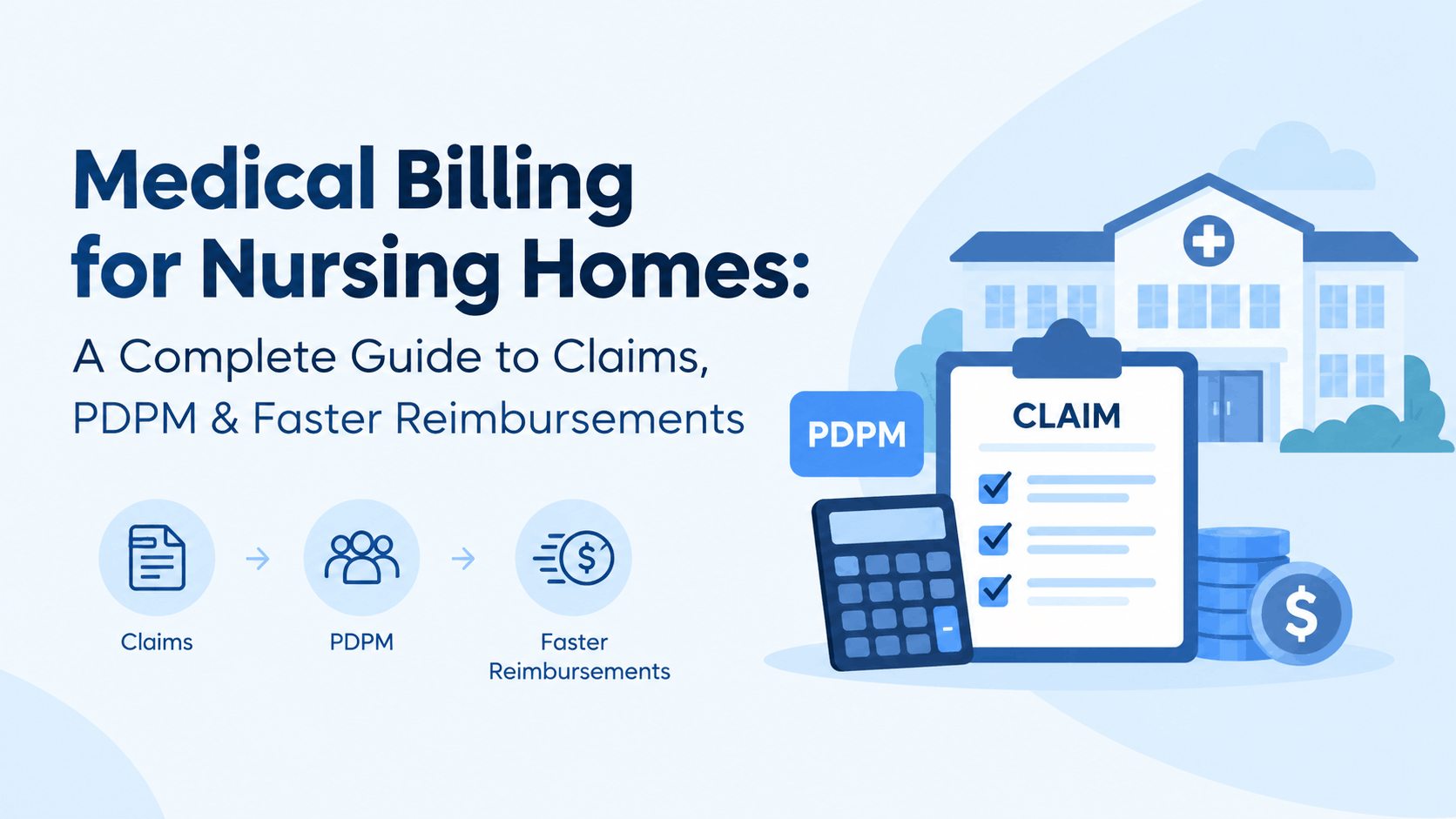
Running a nursing home means balancing resident care, staffing, compliance and finances at the same time. Billing is often where cash flow quietly leaks away. Medical billing for nursing homes is very different from billing for a physician’s office. It involves multiple payers, assessment-driven payment models, strict documentation rules and long-running resident accounts that can stay open for months or years.
This explains how nursing home billing works, where facilities lose revenue, and what you can do to improve reimbursements and reduce administrative pressure.
Medical billing for nursing homes is the process of turning the care a facility delivers into accurate claims, submitting them to the right payers, and following up until payment is received. It covers everything from admission to final payment posting, including eligibility checks, charge capture, claim submission, denial management and resident billing.
Nursing homes, also called skilled nursing facilities (SNFs) or long-term care (LTC) facilities, bill differently from other providers for several reasons:
Most outpatient practices bill per visit. Nursing homes bill per day, per stay, per resident and per payer, often at the same time. A single resident’s account may include a Medicare Part A stay, then a switch to Medicaid, with Part B therapy or a Medicare Advantage plan in between.
Several factors add to the complexity:
Understanding your payer mix is the foundation of a healthy revenue cycle. Each payer has its own claim requirements, authorization rules and payment timelines.
| Payer | What It Typically Covers | Billing Considerations |
|---|---|---|
| Medicare Part A | Skilled nursing care following a qualifying hospital stay | Requires a qualifying inpatient stay, skilled need documentation and accurate MDS assessments |
| Medicare Part B | Outpatient therapy, physician services, certain supplies and diagnostics | Requires correct coding, medical necessity and proper consolidated billing coordination |
| Medicare Advantage | Skilled nursing care through private plans | Prior authorization, concurrent reviews and plan-specific rules are common |
| Medicaid | Long-term custodial and nursing facility care | State-specific rules, eligibility redeterminations and patient liability calculations |
| Private insurance | Varies by policy | Benefit verification and authorization tracking are essential |
| Private pay | Residents paying out of pocket | Clear contracts, invoicing and collection processes |
Since October 2019, Medicare has reimbursed skilled nursing facilities through the Patient Driven Payment Model (PDPM). PDPM bases payment on the resident’s clinical characteristics and care needs rather than on the volume of therapy minutes delivered.
Under PDPM, the daily rate is built from several components:
Rates for some components also change over the length of the stay. For example, the PT and OT components decrease at set intervals later in a stay, and the NTA component is adjusted at the start of a stay.
Why does this matter for billing? The MDS assessment is the source data for PDPM. If diagnoses are not captured properly, or if an assessment is completed late or inconsistently, the facility can be underpaid for the care it actually provided. Billing and clinical teams need to work closely together, because a missed diagnosis or an incorrect assessment date translates directly into lost revenue.
A clean billing workflow prevents most problems before they reach the payer. Here is how a well-run process typically looks:
Even experienced facilities run into recurring billing problems. These are the ones that most often hurt cash flow:
Denials are one of the biggest drains on nursing home revenue. Many of them are preventable with the right front-end and back-end controls:
Strong billing does not happen by accident. Facilities that get paid faster usually follow a consistent set of habits:
Many facilities struggle with this decision. Both options can work, but the trade-offs are different.
Outsourcing tends to make the most sense for facilities dealing with high denial rates, growing A/R, staff turnover or limited in-house billing expertise.
Not every billing company understands long-term care, so it pays to choose a partner carefully. Look for proven experience with SNF and long-term care billing workflows, along with a working knowledge of PDPM, MDS-driven reimbursement and consolidated billing. A strong partner should also have a structured denial management and appeals process, so rejected claims are followed up on and not written off.
Beyond billing expertise, the right partner should be transparent and easy to work with. Look for clear reporting and regular performance reviews, HIPAA-compliant systems that keep resident data secure, and dedicated account support with open communication. Just as important, they should be flexible enough to work with your existing software and processes, so you don’t have to overhaul your operations to get better results.
Your team should be focused on resident care, not chasing payers and correcting claim errors. At IPIRCM – Intelligent Process Inside LLC, our medical billing services are built to help healthcare providers, including nursing homes and long-term care facilities, reduce claim rejections, speed up reimbursements and improve financial visibility. Whether you need to clean up an aging A/R backlog or build a more reliable billing process, we are ready to help. Call us at 877-422-7221, email info@ipircm.com, or book your appointment at ipircm.com/appointment-form today to get a free quote.


“We built IPIRCM to set standards, not follow trends — helping your practice move forward without limits.”
We didn't build these companies to follow trends — we built them to set standards. From IPIPAK's trusted BPO, to IPIRCM's full-cycle U.S. medical billing, to IPITECHNO's cutting-edge IT solutions, every company exists to move your business forward without limits.
Together we are more than three brands. We are one vision: to make business simpler, faster, and stronger for those who dare to grow. It is an honor to lead this group — and a greater honor to serve you.