5600 Palm Lake Circle, Orlando Fl. 32819
info@ipircm.com
877-422-7221

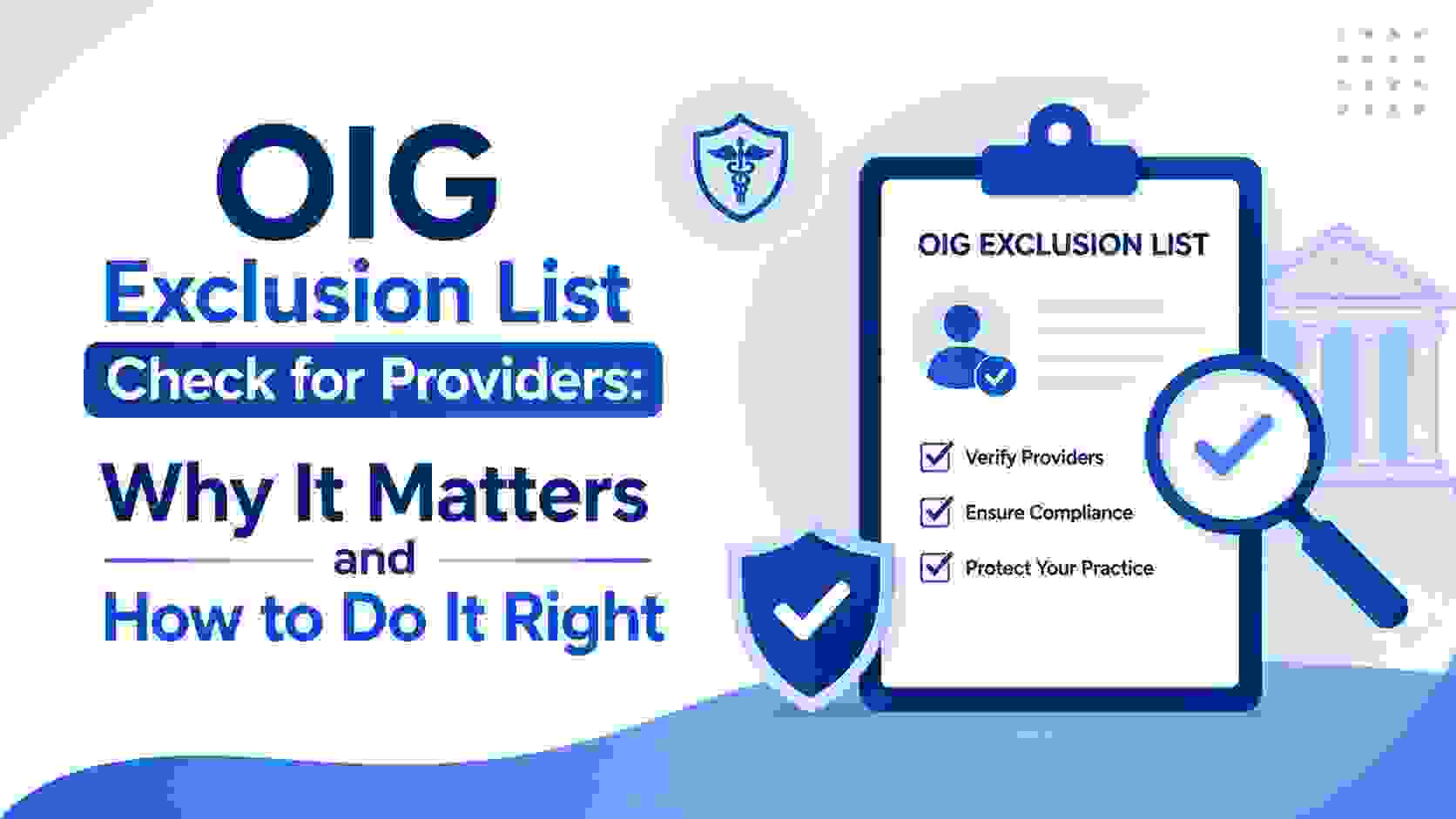
Billing Medicare or Medicaid for services performed by an excluded individual or entity is one of the fastest ways a practice can end up facing repayment demands, civil penalties, or worse. The rule is strict: if a provider, employee, or vendor appears on the OIG exclusion list, the practice cannot bill federal healthcare programs for anything connected to that person, even if the work itself was done correctly.
Many practices assume this only applies to physicians. In reality, it covers nurses, billing staff, office managers, contracted vendors, and anyone else whose work touches a claim paid by a federal program. Understanding how the exclusion list works and building a habit of checking it consistently protects both revenue and reputation.
The Office of Inspector General (OIG), part of the U.S. Department of Health and Human Services, maintains the List of Excluded Individuals and Entities (LEIE). This is a database of people and organizations barred from participating in Medicare, Medicaid, and other federal healthcare programs, usually due to fraud, patient abuse, license revocation, or program-related convictions.
There is also a separate but related list, the System for Award Management (SAM), which covers exclusions across all federal programs, not just healthcare. Many compliance programs check both.
Not every exclusion happens for the same reason, and understanding the distinction helps explain why the list changes so often. OIG exclusions fall into two categories, and both carry the same billing restrictions once someone is listed.
Mandatory exclusions are required by law and apply to individuals convicted of program-related fraud, patient abuse or neglect, felony convictions related to controlled substances, or healthcare-related felony convictions. These carry a minimum exclusion period, often five years, though repeat offenses can extend it significantly.
Permissive exclusions are at OIG’s discretion and cover a broader range of situations, including license revocation or suspension, submission of false claims, defaulting on health education loans, or exclusion from a state healthcare program. Permissive exclusions can be shorter or longer depending on the circumstances, and some remain indefinite until the underlying issue is resolved.
The consequences of billing for an excluded individual go beyond a single denied claim. Under the Civil Monetary Penalties Law, practices can face penalties of thousands of dollars per claim, in addition to being required to repay all federal funds received for services connected to the excluded person. In cases involving a pattern of noncompliance, practices can also face exclusion themselves, which effectively shuts down their ability to bill Medicare or Medicaid entirely.
Liability applies regardless of intent. A practice that unknowingly employed an excluded individual is still responsible for repayment and penalties, which is why proactive screening matters far more than reactive cleanup after a problem is discovered.
The exclusion check isn’t limited to licensed clinicians. Practices are expected to screen anyone whose role could result in a claim being submitted for federal reimbursement.
A one-time check at hiring isn’t enough, since a person or entity can be added to the exclusion list at any point after they’ve already started working for a practice. OIG updates the LEIE monthly, and staying compliant means checking on a recurring schedule rather than treating it as a single task.
Best practice timing:
The process itself is straightforward, but consistency is where most practices fall short. Searching the LEIE database by name returns potential matches, which then need to be verified using additional identifiers like date of birth or National Provider Identifier (NPI) to rule out false positives from common names.
Steps to follow:
If a check reveals that someone on staff or under contract is excluded, the practice needs to act immediately rather than waiting for further guidance. Continuing to bill for services connected to that person, even unknowingly, creates liability that grows the longer it goes unaddressed.
The individual should be removed from any role connected to federal program billing right away, and any claims already submitted involving their work need to be reviewed. Depending on the situation, self-disclosure to the OIG may reduce potential penalties compared to waiting for the issue to be discovered during an audit.
Exclusion screening sounds simple, but a few recurring gaps cause real problems.
Exclusion isn’t always permanent. Once the exclusion period ends, an individual or entity must apply for reinstatement rather than automatically regaining eligibility. Until OIG formally approves that application, the person remains excluded even if the original time period has technically passed. This is a detail that often catches practices off guard, since assuming someone is clear simply because enough time has gone by can still result in billing violations. Any reinstatement should be verified directly against the LEIE rather than assumed based on a calendar date.
Exclusion screening is sometimes confused with other verification steps in the credentialing process, but each serves a different purpose. License verification confirms a provider is legally allowed to practice in a given state. NPI verification confirms a provider’s identity within federal systems. Exclusion screening is separate from both and specifically confirms eligibility to participate in federal healthcare programs. A provider can hold an active license and a valid NPI and still be excluded, which is why exclusion checks need to happen independently rather than being treated as automatically covered by standard credentialing.
A reliable exclusion screening process works best when it’s built into existing workflows rather than treated as a separate task. Tying monthly checks to payroll cycles, credentialing renewals, or existing compliance audits makes it far less likely that a check gets missed. Assigning clear ownership, whether to a compliance officer, credentialing coordinator, or billing manager, also removes the ambiguity that often leads to gaps in the first place.
Keeping up with monthly OIG exclusion checks across every provider, employee, and vendor is easy to overlook when a practice is focused on patient care. At IPIRCM, our Credentialing & Enrollment service includes ongoing compliance screening as part of the credentialing process, helping practices catch exclusion issues before they turn into billing liabilities. If you want a reliable system for staying compliant, reach out to IPIRCM at 877-422-7221 or visit ipircm.com to schedule a free consultation.


“We built IPIRCM to set standards, not follow trends — helping your practice move forward without limits.”
We didn't build these companies to follow trends — we built them to set standards. From IPIPAK's trusted BPO, to IPIRCM's full-cycle U.S. medical billing, to IPITECHNO's cutting-edge IT solutions, every company exists to move your business forward without limits.
Together we are more than three brands. We are one vision: to make business simpler, faster, and stronger for those who dare to grow. It is an honor to lead this group — and a greater honor to serve you.